






Performance Racing Tactics
9.1 Introduction
9.2 Reaching Strategy
9.3 Reaching Tactics
9.1 Introduction
This is not the time to have lunch. It is time to get to work. Have half your crew eat lunch sitting on the rail going up wind. Let the other half go hungry. Sailing downwind, we need the entire crew’s efforts. There is much to do: Trim the spinnaker sheet, guy and pole, trim the main, call tactics, look back for shifts (and the competition, hopefully), find the mark, and more. This chapter will cover Reaching Strategy and Tactics. We will look first at reaching strategy, and then tactics, in a variety of conditions. We will consider how tactics change with the type of fleet you are racing in, and where you fit into the crowd. Running Strategy and Tactics is an entirely different animal, and has a chapter all its own. Rules for reaching and running are covered in Chapter 11: Downwind Rules, Mark Roundings and Finishing. General Strategy

I’d like to open this section with a couple of revelations: First, the shortest distance between two points is a straight line. (Until your boat speed approaches the speed of light this will remain essentially true.) Second, you will not pass anyone until you are going faster than they are. Add also the corollary: If you can sail faster than the boats behind you, you’ll never have to look back (Fig. 1).
Reaching strategy can be built on these two fundamentals:
Sail the Rhumb Line.
Sail Fast!
9.2 Reaching Strategy
Wind, Wind Shifts, and Current
With the two fundamentals of reaching strategy forming our framework, we can now apply the elements of strategy: Wind, wind shifts, and current. As with our earlier discussion of upwind strategy, we will first look at the strategic factors to analyze how we would sail around the course in the absence of other boats. Then we will add other boats and consider tactical issues. Wind
The first deviation from our fundamental rhumb line strategy revolves around changing wind conditions. “Off in the Puffs, Up in the Lulls”

The phrase is repeated so often that it is cliched. It is also good strategy. In fluctuating winds, bear off below the rhumb line in a puff to stay in the puff longer. In a lull, reach up to hold speed, and to reach the next puff sooner. We all tend to sail down to but not below the rhumb line in puffs, and above it in lulls. This is both to protect clear air, and because it feels fast to reach up a little higher. Trouble is, it leaves you above the rhumb line and forces you to reach off later. Avoid this if you can. Sail below the rhumb line in puffs, so you can preserve your fast reaching angle later in the leg (Fig. 2).
Off in puffs, up in the lulls is sound reaching strategy. It is not always true on runs, as we will see in the next chapter.
Building Breeze / Fading Breeze
Don’t wait for a building breeze to come to you go up and get it. Think of a building breeze as one long lull followed by one long puff. Go up in the lull and off in the puff to get the best overall performance. You make big gains by aggressively pursuing a new wind. Be bold (Fig. 3).

In a fading breeze, the same strategy applies in reverse. The existing wind is a relative puff sail low in it and reach up as the breeze fades (Fig. 4). This is a difficult strategy to pursue as tactical considerations often overwhelm it. Sailing low invites those behind to sail over you and to steal what wind you have. If you can hold low and keep clear air, your dividends will be big. Reaching up in the lighter air will give you a real boost. It will also push your apparent wind angle forward so your air will be more difficult to steal.
Wind Shifts
Oscillating Wind Shifts
Oscillating conditions will often feel like puff and lull conditions and should be treated that way. As the wind shifts aft (a lift), the apparent wind will decrease. Head up to maintain apparent wind strength and boat speed. Similarly, as the wind shifts forward, drive off. Use the favorable wind angle to push down, below the rhumb line course (Fig. 5).

You should not head up one degree for each degree of lift, nor should you drive off as many degrees as the wind shifts forward. You must balance the extra speed with the extra sailing distance to arrive at the optimum course and speed. A change of course roughly half the angle of the shift seems a good place to start.
Persistent Wind Shifts
In a persistent, gradual header, sail above the rhumb line initially and let the shift push you down to the mark (Fig. 6). In a gradual lift, the correct strategy is to sail low initially, and then reach up to the mark as the wind shifts aft (Fig. 7).

Sailing low in anticipation of a lift is a difficult strategy to follow. Sailing lower and slower is not a performance choice we make easily and the reality of tactics makes it hard to do, as other boats may sail over us as we pursue the strategy. If you have the discipline to work low in the early part of a reach in a persistent lift, and if you can keep clear air, then you will reap big gains later in the leg, as you approach the mark with a favorable wind angle. In persistent shifts, as with oscillations, you must balance the speed versus distance trade-offs to determine how far off the rhumb line to sail.
Current
Current creates great strategic opportunity on reaches. The first trick, of course, is to know what the current is going to do. In this section we’ll take a look at strategy for current which is consistent over the leg, and also for current which varies in strength down the leg. For a discussion of current forecasting, see Chapter 13: Weather later in this book.
Steady Current
When current strength and direction are consistent over the length of the leg, the strategic goal is to correct for it by steering a course which holds you on the rhumb line.
If the current is pushing you to leeward you can head up and sail a faster reaching angle. The current will then push you down to the mark (Fig. 8).

Conversely, if the current is pushing you to windward, you must drive off to compensate. It is in these conditions that your efforts to correct for the current are particularly important. If you fail to correct for current as it pushes you to windward, you will eventually have to sail down into it at an increasingly unfavorable reaching angle (Fig. 9).
Correcting for Current

How can you tell if the course you are steering is compensating fully for the current? There are several ways (Fig. 10): shore, you are steering the correct angle to compensate for the current. Note that the course you steer may vary as your boat speed changes with changing wind conditions.
Use a bearing, back bearing, or back range. If you cannot establish a range ahead, try a bearing to the mark ahead, a back bearing to the mark you just rounded, or a back range through that mark to shore. You will be able to see if you are being pushed off your rhumb line course.
Use the Course Over Ground (also know as Course Made Good) function on your LORAN or GPS. If you do not have any objects to sight, then COG can give you course information. This information is not sound until you have been on course for some time. The averaging and sampling time varies from brand to brand.
The current rarely pushes you either directly to windward or leeward. Usually there is a component of the current aligned with the course. The current may be from your weather quarter, or leeward bow, or whatever
The component of the current which is aligned with the course, either on the bow or on the stern, effectively lengthens or shortens the leg. The case where the current is at your stern is the more interesting, as it tends to exaggerate the impact of any distance you are pushed laterally. Boats which are high of course will have to bear off even more to get down to the mark, compounding their difficulties (as in fig 9 on the previous page). If they fail to compensate sufficiently, they may be swept past the mark. This is particularly true in lighter winds, where performance suffers most on broader reaches.
Variable Current
When current varies down the leg, it can become a key strategic factor. We’ll look at four permutations, though countless other scenarios are possible.
Current pushing to leeward and strongest at the outset:

If you are on a close reach and having difficulty holding the rhumb line, fear not. As the current abates, you will not have to sail such a high compass course to make the mark. Furthermore, less current will shift your apparent wind aft, allowing you to sail a higher compass course with the same apparent wind angle (Fig. 11). For further discussion of the current’s impact on sailing wind, see Chapter 13: Weather.
Current pushing to leeward and strongest at the end:

On a close reach you will want to set up by sailing a high line early to assure a fetch. On a broader reach don’t hesitate to sail a higher, faster reaching angle early on, with the knowledge that the current will set you down to the mark later in the leg (Fig. 12).
Current pushing to weather and strongest at the outset:

Reach up to get across the current quickly, and you’ll spend less time fighting it. But beware: the higher you go early, the lower you will have to sail later, once you are out of the current (Fig. 13).
Current pushing to weather and strongest at the end:

This case holds the greatest opportunities, as those who do not anticipate the current’s set are at a distinct disadvantage. As boats are pushed to weather, they are forced to sail a lower and slower reaching angle to compensate. This slower course increases the relative strength of the current and compounds the error. Those who anticipate the current’s push and set up low of the rhumb line will gain. Obviously, the lighter the wind and stronger the current the greater the impact. A diminishing wind and strengthening current can create devastating results (Fig. 14).
Reaching Strategy Conclusion
Sail Fast, Sail the Rhumb Line. Sometimes strategy is just that simple. Variables of wind, wind shifts, and current can add some complexity, but the real excitement comes with tactics or lots of wind. The tactical battle for clear air and for position at roundings or in passing lanes is where the action is.
Reaches can become parades. In similar size boats, passing can be difficult. Leaders tend to stretch out their advantage by following the sail fast, sail straight principles, while the rest of the fleet struggles. In mixed fleets, big boats which have failed to round ahead roll up through the fleet, with the smaller boats unable to stop them. It is no wonder that, to avoid reaching parades, more and more races are being run on windward-leeward courses . Onward to Reaching Tactics, where we will battle for clear air and work to achieve our strategic goals.
9.3 Reaching Tactics
Reaching tactics depend on our goals for the leg and the conditions in which they are sailed. In boats of similar size and speed passing other boats can be a difficult (and risky) undertaking. You must decide if your primary goal is to pass boats, or to simply stretch out your lead on those behind while closing the gap on those ahead. That decision depends on your current position in the race and the opportunities you expect down the road. Sometimes the status quo is just fine sometimes it is best to wait until the next leg to pursue a more aggressive strategy.
Much of reaching tactics revolves around keeping clear air. Without clear air there is little chance for success. The struggle for clear air can tear us away from our strategy. Much of the tactical discussion will revolve around how to keep clear air, and how to balance that effort with our wind and current strategy for the leg. The battle to preserve clear air tends to push the fleet above the rhumb line on reaches. The higher course early in the leg, and lower course later in the leg, makes the second half of the reach slower than the first half. As the pack compresses later in the leg, tactical opportunities increase. Careful positioning early in the leg can bring rewards later on, and careless positioning can lead to disaster.

Often the first few boats to round are able to hold to the rhumb line, while the pack sails extra distance in the struggle to preserve clear air. Consequently, the leaders tend to get away leaving the pack behind (Fig. 15).
Passing Other Boats
The most obvious tactical goal on a reach is to pass those ahead of you; the obvious first step in that tactic is to sail faster than those ahead. You’ll have a hard time passing them if you don’t catch them first. Sail fast. (WOW, really?) Sail fast, but don’t sail high. The easiest way to build speed is to reach up. But it is also risky. As you sail up the boats ahead will reach up too. You will be adding mileage to the leg without closing in on those ahead. You will lose to other boats which sail less distance.
Behave. Don’t sail high. Catch your rival by sailing faster without sailing higher. Sail right up his transom, or aim at the leeward quarter. This nonthreatening approach will save you from sailing extra distance, and it may lull the rival into complacency.

Look for an edge and make your move. Once you are close astern look for an opportunity to pounce on your opponent’s air. You’ll need a puff, or a wave to give you a performance edge. Or use the element of surprise when the other crew is not paying attention. Pounce when they are passing around drinks, or removing excess clothing, or the guy is cleated, or the main unattended (Fig. 16).
Set, Ready, Go.
You have to pounce. Ready, Set, Go takes too long. You must be set to go at any time. Head up quickly. Trim the sheets. Ease the guy. Hike out. Practice your pounce so everyone knows the move. You will succeed if your crew pounces effectively, and the other crew fails to respond properly.
The Passing Lane, Does it Exist?
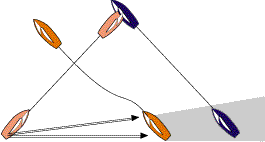
There is a Passing Lane on close reaches. On a shy spinnaker reach you can set up in the passing lane at the outset, by jib reaching to a position where boats with spinnakers can’t get up to your line. As we discussed in Chapter 2: Race Preparation earlier in this book, sailing the course in miniature before the start will help you anticipate how tight the reaching legs will be (Fig. 17).
Not only does the Passing Lane exist; the Get Passed Lane exists too, and there may be times you want to get into it, as we shall see, below.
Defending Your Position
There are several techniques you can use to protect your position and to prevent others from passing you. The correct technique depends on the circumstances. If a group of larger boats is rolling up from behind, it is a waste of time and effort to try to hold them back. When a fleet of larger boats is sailing through you, it is time to get into the get passed lane. The get passed lane is much the same as the passing lane a couple of boat lengths to weather of the fleet line. The idea is to encourage the larger boats to sail through you to leeward, where they won’t sail over your air (Fig. 18).
When the attacking boats are more like you in performance, then you must choose the appropriate defense.
Sail fast.

Sail faster than those behind you and extend your lead! The best defense.
Establish a windward position (Fig. 19).
As you start down the leg, immediately establish a position a boat length or two to weather. This can save you many boat lengths and lots of hassling later. It is much more effective than waiting to see if anyone attacks, and then responding. Setting up early sends the message: you aren’t going by, at least not on the windward side. On close reaches establish a clear air lane by holding high initially, so others can’t get up to you. On a broad reach it can also work to establish weather position early, but this can leave you vulnerable, later in the leg, to boats working for an inside position and buoy room.
Pay attention.

Assign one crew to keep a lookout aft. If the trailing boat makes a move, respond promptly. An exaggerated response will let the other boat know you are paying attention. Make a swift, sharp turn up, then slide back down to as close as you can to course. Holding a high line only lengthens the leg for you. Don’t overreact (Fig. 20).

If you have a lead of two boat lengths or more, then your response should be tempered. The rule of halves works well here head up half as far as the rival to keep position between him and the mark. By sailing only half as far off course you will sail less distance. Don’t forget: The best defense against attack is to extend your lead. All or nothing (Fig. 21).
When under an immediate threat defend vigorously, or not at all. When an opponent makes a move to pass, respond hard and fast, with a vigorous luff and trim. As the attacker responds to your defense, come back down and squirt out to establish a small lead. If you are not prepared for a vigorous defense, you will be better off to let them pass and get on with it. Avoid a halfhearted luffing dual, as you will both go to the moon!
Act First
If your attacker establishes a small overlap on your weather quarter but has yet to make a full run to get over you, a preemptive luff may catch him off guard. The panicked response will leave him in disarray, and your smooth return to course will give you an edge both in position and in psyche.
More Ideas on Defense

Sometimes the battle is not worth it. To let the other boat go by either sail high and wave him through to leeward preferred for you, but he may not take the bait, as he is likely to get stuck there or wave him by to weather. When he passes to weather on a broad reach, you can reach up and hitch a ride by drafting on his stern wave. On a close reach force him to pass to leeward, and try to hitch by sliding down onto his stern wave (Fig. 22). Drafting works best when heavy boats are sailing near hull speed. You will see them towing a big wake. Jump aboard! .
The biggest danger in letting one boat slip by is that the next one may be on your air before you recover. Before you know it, feels like the Fourth of July, as the whole parade passes you by (Fig. 23). Don’t forget to wave the flag!
Outside Reaches, Mark Roundings, and Inside Reaches
There are two kinds of reaches outside reaches where the windward side is to the outside of the mark rounding, and inside reaches where the windward side is inside. Outside reaches lead to jibes, inside reaches lead to leeward marks. The tactics on the two kinds of reaches differ in some important ways (Fig. 24).
Outside Reaches

On outside reaches there are split incentives: sail up for clear air or work down for inside position at the rounding. Tactically a trailing boat can lure a leading boat up and then dive inside for room as the leader squares away for the mark. The closer you are to the mark, the more difficult it is to get the leader to take the bait (Fig. 25). As the leader in that position, it is often best to hold course don’t get suckered up. There are also times, as the leader, when you may actually want to slow down to solidify the attackers overlap on the outside, and prevent him from diving inside as you square away! Obviously any slowing loses you distance to the rest of the fleet, but not as much as you stand to lose if the trailing boat gets buoy room and passes you at the rounding (Fig. 26).
Mark Roundings
Tactics at the jibe depend on your position finishing the inbound leg, and your strategy for the outbound leg. Four general routes cover most circumstances.
Most often the preferred route is to come in wide and go out close. In wide and out close is preferred because it gives you control and clear air as you start the next leg. To do this you’ll need to start your turn early two or more lengths from the mark in order to make a smooth turn and carry speed onto the next leg. Your goal should be to finish your turn, and be on course to the next mark, as you come alongside the jibe mark (Fig. 27a).
The reverse in close and out wide happens when your approach is low. If you are clawing to the mark on a close reach then you may have no choice, and there is little risk. If your approach is low and your rounding is close and wide while others are executing a wide and close the will gain an inside position, limiting your maneuverability and taking your air (Fig. 27b).

In close, out close is hard on your crew, but sometimes tactically necessary. When you are the inside boat, getting room, outside boats and trailing boats will try to cut inside your transom and roll over you. Don’t let ‘em. Warn your crew, and slam the helm to force a tight turn, spinning at the mark. Any room you can get on the approach side will help you come out close on the exit side. With a hard slam, you should be able to round close enough to keep trailing boats from cutting inside (Fig. 28).
An end run can be your best tactic when a large fleet converges on the mark in very light winds. These situations announce themselves with a cacophony of voices, slatting sails, and banging hulls. If you find yourself anywhere but on the inside, consider going way outside (Fig. 29).

Inside Reaches
Inside reaches push the fleet far above the rhumb line, since the lure of clear air and inside position at the rounding lie on the same side. If you are the lead boat in a group, it pays to establish an inside position immediately. As you clear the jibe mark sail up a length or two before settling down on course. If you don’t establish this strong position, others will be tempted to attack. You will driven up further in the end, as you work to defend a weak position (Fig. 30).

If you find yourself in the middle of a crowd on an inside reach, it pays to work to the inside early. Inside position and clear air will be decisive factors, particularly as the fleet converges for the rounding (Fig. 31a).

On a broad reach the tendency to sail high can push the fleet over the mark, where it becomes necessary to jibe back. It is a common error to sail too broad at the end of an inside reach in an effort to avoid jibes. For those with the boat handling skills to jibe well there is much to be gained by sailing fast angles, and jibing into the mark (Fig. 31b).
Two other ideas deserve mention:
First, if you are part of a small group, particularly near the lead, talk with your rivals and avoid fights. “Yo, old buddy old pal, let’s not us get into a snit. Let’s sail fast and straight, and get away from the teaming masses, hot on our �tails.” Once your lead group breaks away from the crowd, you can start infighting, but it is definitely worth it to break away first. Second, if you are well behind, there is an opportunity for an heroic end run. Rather than get suckered up by the crowd, sail low on or below the rhumb line while the fleet sails high. Later in the leg, as the fleet squares away to slow reaching angles, and they choke on each other’s bad air, you can beam reach across the bottom of the leg, and pass the crowd. Your chances for success are enhanced by light air and adverse current, and the risks are slight (Fig. 31c). I’m proud to mention that I was crewing in the Etchells 22 North Americans one Autumn, when we went from 29th to 8th in one leg, with just such a tactic! (Regrettably, space does not allow me to recount how we arrived at the jibe mark 29th.)
Final Thoughts on Reaching Tactics
Mixed Fleet Tactics
In a mixed PHRF fleet with a broad range of handicaps, the importance of tactics is diminished. You are racing the clock more than other boats. Boats nearby are obstacles, more than rivals, if they rate differently than you. Negotiate peace and sail your boat.
If you are in a small boat near the head of the pack as you turn down the reaches, the get passed lane may be the place for you. Also, work for position to hitch a ride and surf a passing boat’s stern wave.
As a big boat in the lead, you must get away from the crowd. Any time you waste diddling with other boats will cost you double, as every moment you spend with slower rated boats leaves you less time to build a sufficient time margin. When working to pass a fleet of smaller boats get up and over the crowd, or well below them. Beware the low road. Although you may be able to sail through one or two smaller boats with ease the cumulative wind shadow of a gaggle of them can prevent you from getting through. If your boat performs poorly on reaches, you should work to clog things up for the fast reaching boats. Once you round the windward mark in good position you can hold off the fast boats two ways: One is to establish a position to weather, as described earlier (See Fig. 19). The other is to set up low, and luff. This can have a cumulative effect. As you luff one boat he will push up the next boat and so on. You can clog up the entire fleet this way.
Heavy Air Tactics
While most of the forgoing tactics apply in all wind conditions, there are some special opportunities in heavy air. Light to moderate winds result in similar sailing speeds for similar boats, but speed differences can be pronounced in heavy air. As the breeze comes on, shift your focus from tactics to performance. Get clear and sail fast the best tactic of all.
Reaching or Running?
Very broad reaches should often be treated as runs. If the angle is broader than the proper sailing angle then strategically the leg is a skewed run. Even if the leg doesn’t initially warrant running tactics, you may need to change modes, if you find yourself well above the rhumb line (Fig. 32).


